APD in Everyday School Life: When Listening Becomes a Challenge – Accommodations, Visualization & Speech-to-Text Interpreting
Auditory Processing Disorder (APD) in children: How targeted reasonable accommodations, classroom visualization, and speech-to-text interpreting eliminate barriers.
Around five percent of all school children experience severe difficulties understanding spoken speech – despite having completely healthy ears. With an Auditory Processing Disorder (APD / AVWS), peripheral hearing is fully intact, but the brain struggles to accurately filter, decode, and process acoustic information. What does this mean for everyday schooling, what support do educational authorities offer through reasonable accommodations, and why are visualization and speech-to-text interpreting essential for equal opportunity?
What Does APD Mean for Children and Teenagers?
Auditory Processing Disorders (APD) are circumscribed functional deficits in central auditory processing and perception occurring alongside at least average non-verbal intelligence (cf. Kiese-Himmel, 2011). Affected children are frequently misjudged in class – often perceived as daydreaming, distracted, or lacking concentration. In many cases, children do not even realize themselves that an auditory processing deficit exists, simply because what they hear feels "normal" to them.
Common Classroom Symptoms:
- Difficulty Hearing in Background Noise: In noisy or reverberant classrooms, comprehension plummets because ambient sound cannot be tuned out.
- Confusing Similar-Sounding Words: Distinguishing similar phonemes (such as cap – map or voiced vs. unvoiced consonants like D/T, B/P) is blurred.
- Overload with Multi-Step Instructions: The auditory short-term and working memory struggles to retain long verbal instruction chains.
- Hypersensitivity to Noise (Hyperacusis): School corridors, playgrounds, cafeterias, or sports halls can quickly cause sensory overload.
- Compensation via Lip-Reading: Children compensate by intensely observing lip movements, facial expressions, and peers, resulting in severe cognitive fatigue after only a few lessons.
APD rarely occurs in isolation: it often intersects with dyslexia, developmental speech delays, or attention deficits. However, when targeted support measures and accommodations are provided, pupils can flourish according to their genuine cognitive abilities and achieve academic success.
Reasonable Accommodations & Educational Authorities: The Right to Equal Opportunity
Official guidelines issued by educational ministries and regional school boards outline clear standards for supporting pupils with APD. Following a formal medical diagnosis (ENT / phoniatrics / pediatric audiology), pupils are entitled to individual reasonable accommodations (Nachteilsausgleich).
Accommodations do not modify educational standards or the curriculum; instead, they adapt exam conditions and learning environments to compensate for auditory processing deficits:
- Time Extensions: Additional time during exams, written tests, and classroom assignments.
- Alternative Assessment Formats: Prioritizing written assessment formats over purely auditory listening comprehension tasks.
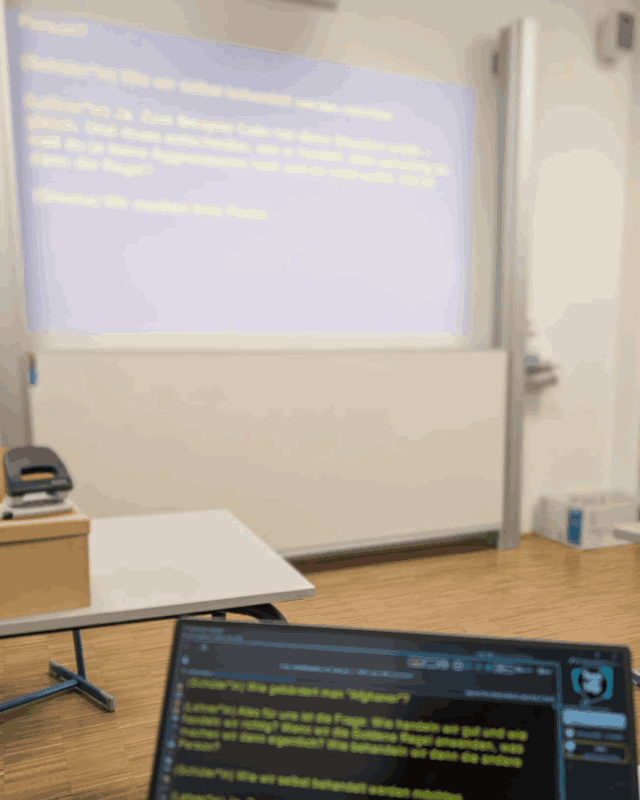
- Classroom Visualization & Written Instructions: Reliable provision of whiteboard summaries, step-by-step task instructions, handouts, and written notes.
- Assistive Technology: Approved use of personal FM/soundfield systems, noise-dampening measures, and live transcription setups.
- Speech-to-Text Interpreting (CART): Dedicated live captioning assistance for higher support requirements – particularly in secondary schools, colleges, and during final graduation exams (e.g. Matura or A-Levels).
Visualization & Speech-to-Text Interpreting: The Foundation for Accessible Learning
Official APD educational guidelines place strong emphasis on visualizing and fixing spoken content in writing. The reason is simple: spoken words are fleeting – written text endures.
This is precisely where professional speech-to-text interpreting in schools comes in:
Real-Time Text on Tablet or Laptop
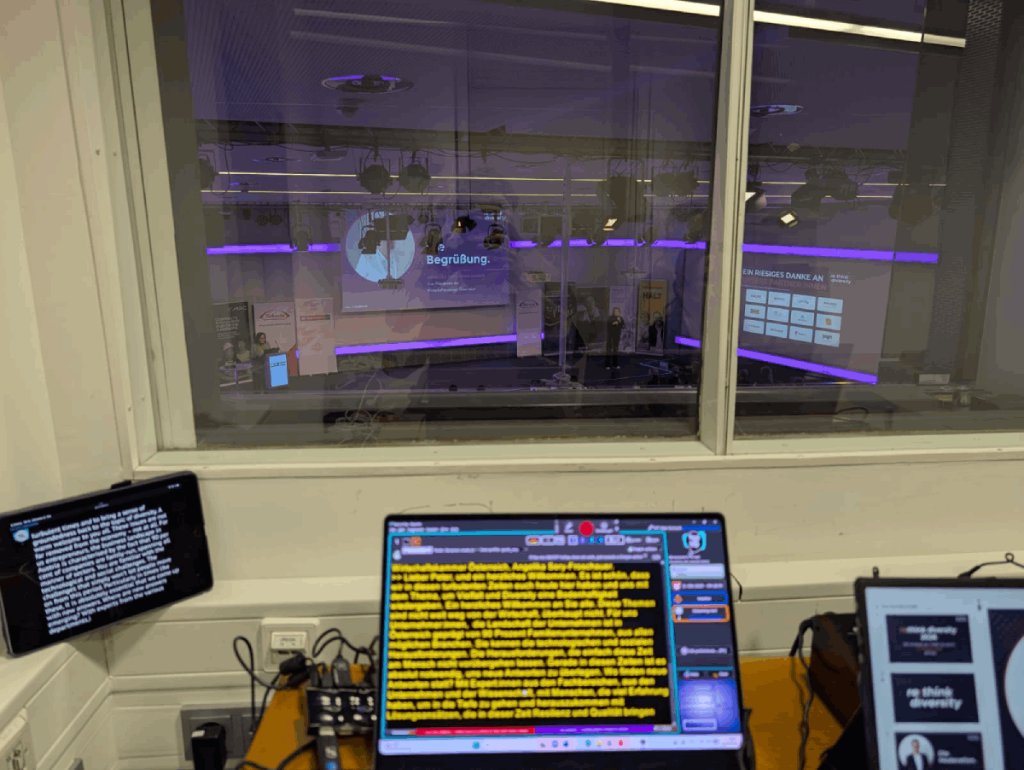
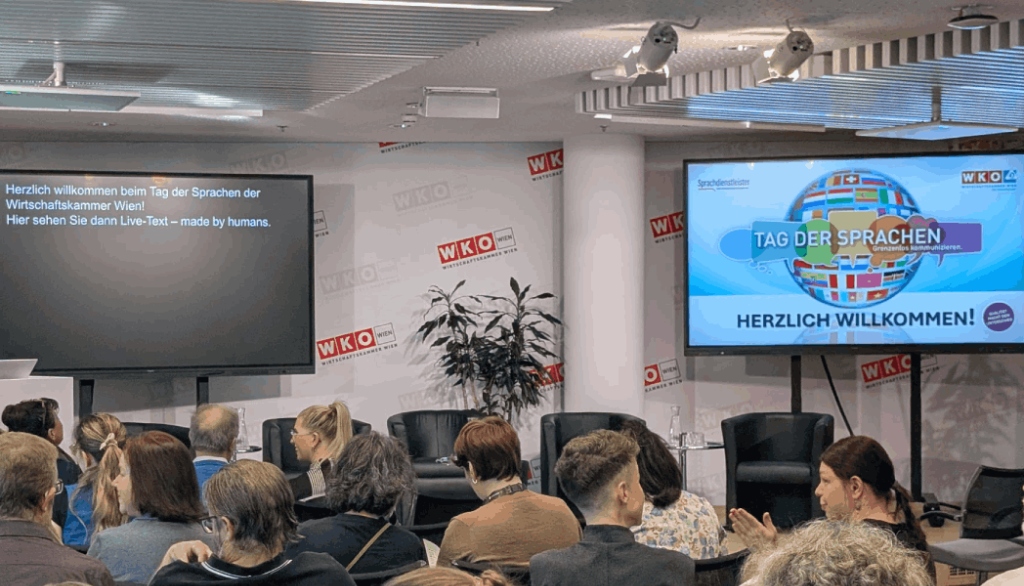
Speech-to-text interpreters simultaneously transcribe teacher instructions and peer contributions into text. The child reads along on their own screen – completely accessible, without delay, and free from the fear of missing critical details.
Complete Class Transcripts
Children with APD cannot simultaneously focus on strenuous active listening and handwriting notes. Complete verbatim or edited transcripts are available right after class for stress-free review at home.
Especially in subjects with high information density or technical terminology (such as physics, chemistry, biology, mathematics, or foreign languages), written transcripts provide vital relief for working memory capacity.
Actionable Recommendations for Classrooms and Home
Tips for Teachers & Classroom Acoustics:
- Optimize Room Acoustics & Reduce Noise: Keep doors and windows closed during instruction; equip chair legs with felt pads; reduce reverberation using curtains, bookshelves, or acoustic panels.
- Strategic Seating Position: Seat the pupil within two meters of the teacher; ensure unobstructed line of sight for lip-reading; keep away from noise sources (projector fans, radiators, doors).
- Instructional Delivery: Secure eye contact before giving instructions, speak at a measured pace, pause between thoughts, and always display task steps visibly on the board.
- Pre-Clarify Specialized Terminology: Introduce and write out new technical terms before deep dives, preventing children from losing the thread while deciphering unknown word sounds.
Tips and Guidance for Parents:
- Distraction-Free Homework Space: Consistently turn off background noise (TV, radio, washing machines) during study sessions.
- Clear, Structured Instructions: Deliver tasks step by step – avoid bundling three separate requests into a single complex sentence.
- Allow Decompression Time: Children with APD perform acoustic heavy-lifting throughout the school morning. They urgently need quiet downtime after school to recharge.
- Proactive Dialogue with School Authorities: Use official ministerial APD guidelines as a solid basis for parent-teacher conferences and accommodation agreements.
Conclusion: Supporting Auditory Processing with Intention
An Auditory Processing Disorder must never be a barrier to achieving educational potential. With empathy and understanding from teachers, approved reasonable accommodations, and the powerful synergy of classroom visualization and professional speech-to-text interpreting, school once again becomes a place where children with APD can learn with confidence and thrive.
Request Speech-to-Text Interpreting for Education
Would you like to learn more about funded speech-to-text interpreting (CART) in schools or need guidance on applying for accommodations with educational authorities? Sprachpilot is happy to provide non-binding consultation.
More News